Choosing the Right Collar, Harness, and Leash for Your Dog

Harness vs. Collar
For most dogs, a harness is the best option for walking.
Harnesses distribute pressure across the dog’s body rather than concentrating it on the neck. This matters because the neck contains sensitive structures such as the larynx and trachea, which can be irritated when pressure is applied repeatedly through a collar.
Harnesses also allow us to guide the dog’s movement without putting pressure on the throat.
That said, collars still have a role. Some dogs who are prone to slipping out of equipment may benefit from a martingale-style collar or slip lead as a safety backup. Another option is clipping the leash to both a harness and a martingale collar so that if the dog slips the harness, the collar provides an additional layer of security.
For dogs that walk comfortably without pulling, a martingale or slip lead may also work well.
Why We Prefer H-Style Harnesses
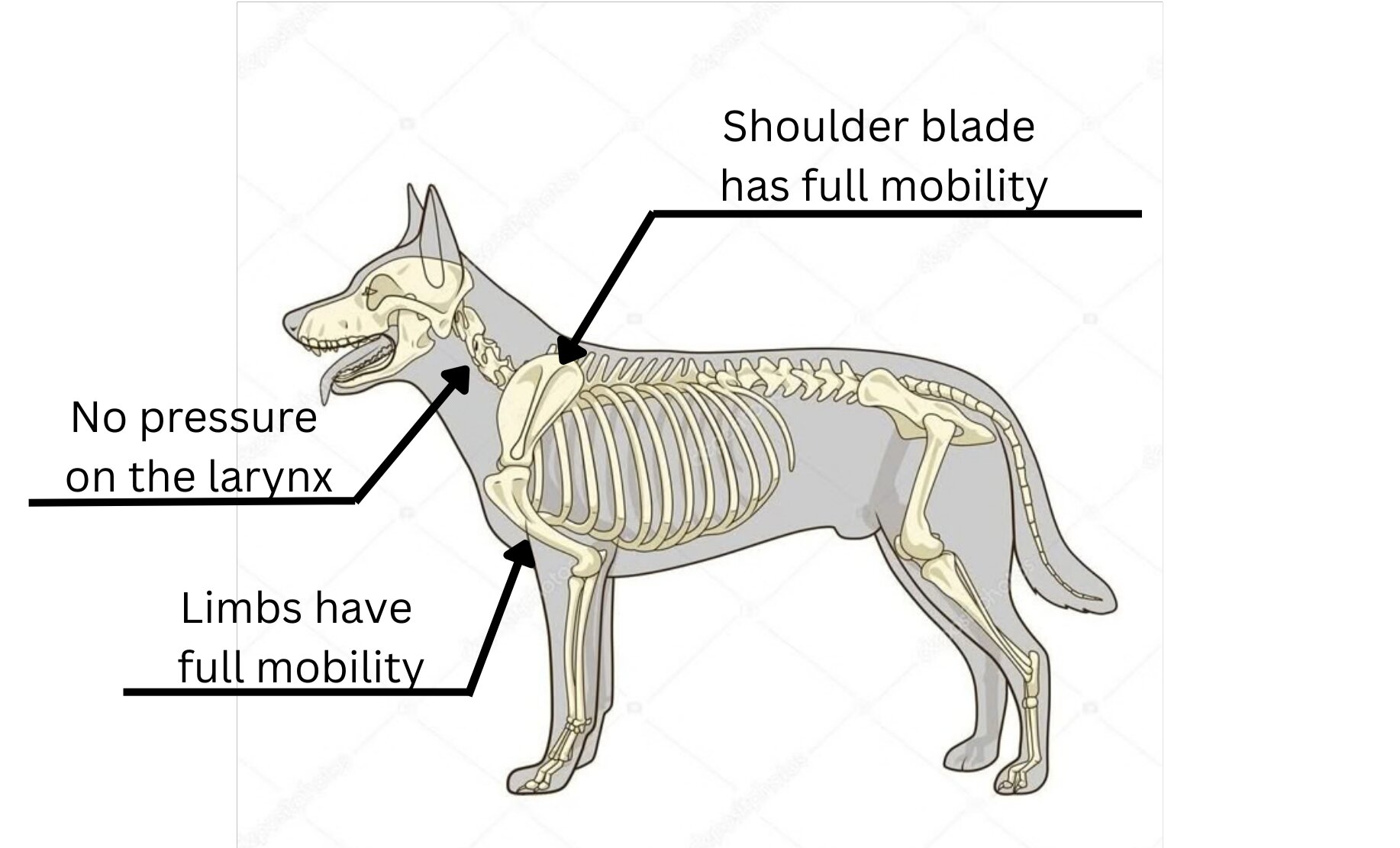
Not all harnesses are built the same. Our preference is an H-style harness.
This style has straps that run:
- around the collarbone
- around the ribcage
- with a connecting strap along the chest and back
This design has a few advantages:
- No pressure on the throat or larynx
- No restriction of the front legs
- Allows full shoulder movement
A dog’s shoulder anatomy is different from ours. In humans, the shoulder blade connects to the skeleton through joints. In dogs, the shoulder blade is largely free-floating and connected by muscle. Because of this, pressure across the shoulder area can restrict movement and create discomfort.
Harnesses that run straight across the chest or shoulders can interfere with this natural motion.
Novelty “No-Pull” Harnesses
There are many harnesses marketed as “no-pull,” “easy walk,” or “redirecting” harnesses. These designs often use a front leash attachment or strap placement intended to turn the dog when they pull.
In many cases, these harnesses work initially because they create frustration or awkward movement, which interrupts the dog’s pulling behavior. Over time, however, dogs frequently adapt to the sensation, and the harness simply becomes part of the background.
When that happens, the original pulling behavior tends to return.
Another consideration is that many of these designs place pressure across the front of the shoulders or forelimbs, which can interfere with natural movement. This can add tension in situations where the dog is already excited or stressed.
For these reasons, we typically recommend focusing on comfortable equipment and training, rather than relying on novelty harness designs to solve pulling.
Choosing the Right Leash Length
Leash length should match both the environment and the handler’s comfort level.
A 6-foot leash is the most versatile option for everyday walks. It gives your dog enough room to explore while still allowing you to shorten the leash when navigating:
- narrow sidewalks
- crowded areas
- busy crossings
For open spaces such as parks or hiking areas, long lines can be a great option. They allow dogs more freedom to move and explore.
However, long lines do require more handling skill, since excess line can become tangled or create safety issues if not managed carefully.
A Note on Prong Collars
Our preference is to avoid prong collars whenever possible.
However, there are situations where handlers may feel they need additional control, particularly when:
- the dog is very large or strong
- the handler has limited strength or mobility
- safety is a concern during the early stages of training
In these cases, a prong collar may sometimes be used as a temporary management tool while training focuses on building new leash-walking skills. The long-term goal is to shift toward equipment that allows the dog to walk comfortably without relying on corrective pressure.
Our Favorite Harness and Leash
After trying many different products over the years, our favorite harness is the Blue‑9 Balance Harness.
In addition to the H-style design described above, each strap on the Balance Harness is fully adjustable. This allows the harness to be customized to the individual dog’s size and body shape, which can make a big difference in both comfort and fit.
Our preferred leash is from Mountain Dog Products.
These leashes are made from high-quality rock climbing rope, which makes them extremely durable while still being comfortable to handle. They also come with a lifetime, unconditional guarantee, which speaks to the durability of the product.
The Bigger Picture
Equipment alone does not teach leash skills. The leash, collar, or harness simply sets the stage for communication and safety.
With the right setup and a thoughtful training plan, most dogs can learn to move comfortably alongside their person while still having the freedom to explore the world around them.