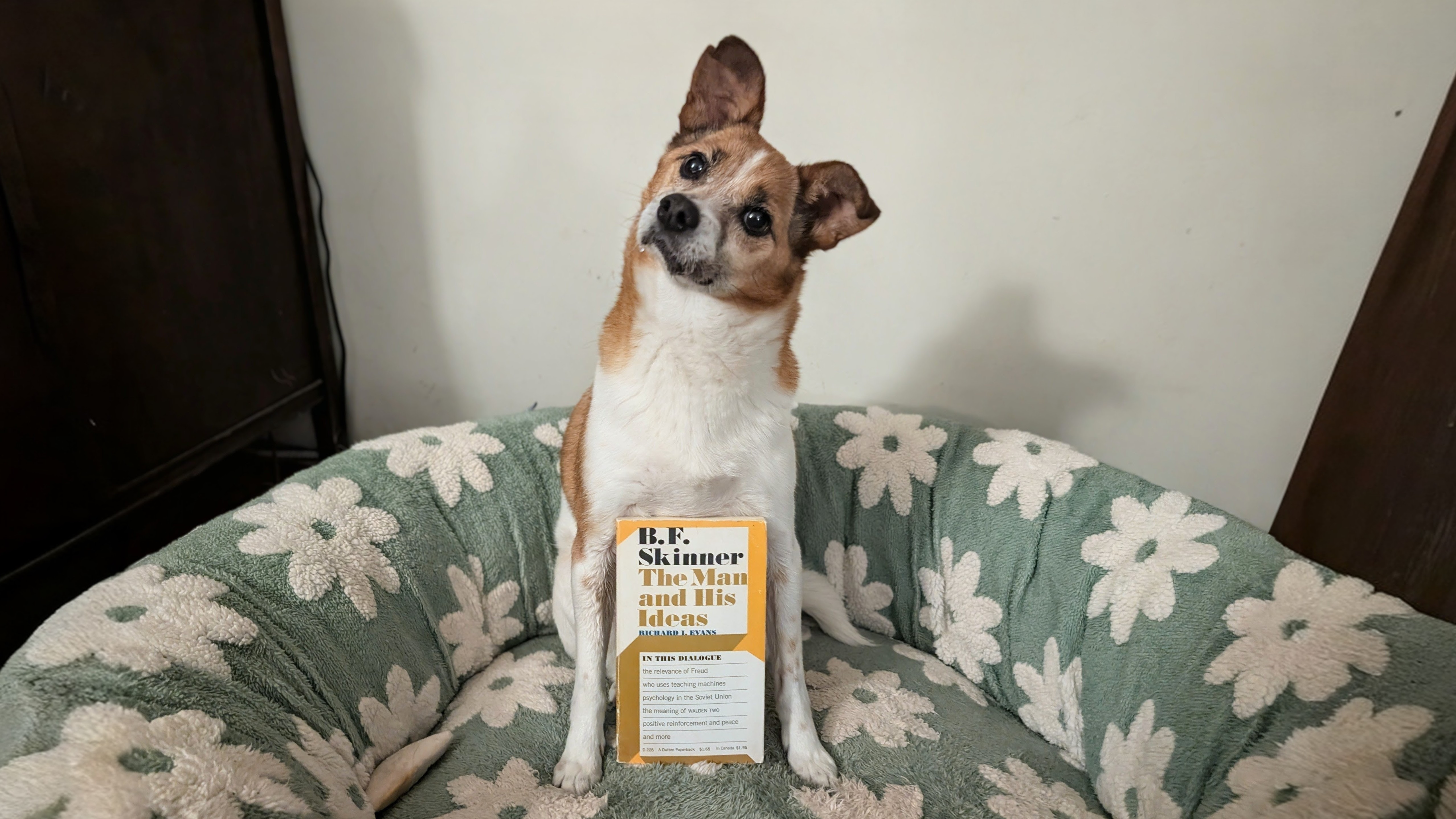
Reading Behavior: “BF Skinner: The Man and His Ideas”, by Richard I. Evans

If you’ve ever tried to wade through one of Skinner’s books, it can be a bit daunting without a formal education in behavioral science. Typically I find myself stopping every few sentences to google a concept, or chase footnotes and references to better understand the content. But this book shows a much more approachable side of BF Skinner. That’s not to say it does not give us some very insightful and memorable quotes that easily apply to our behavior as humans, and the behavior of our dogs.
How We Shape Our Dog's World
We often talk about a dog’s “personality” as if it’s set in stone, but Skinner suggests that even “awareness” is shaped through interaction with the social environment:
“Society makes the individual observe himself—he has no reason to do so otherwise. There is nothing in a nonsocial environment which would ever generate awareness. Awareness is a reaction to a part of the environment—like any other behavior—but it happens to be a part of the environment contained within the organism itself.”
In your dog’s life, you are a major part of their social environment. Your routines, reactions, and patterns of attention help shape what your dog learns to do and what outcomes those behaviors produce.
This thought, inspired by a quote from Anthony Biglan, is relevant here: If you have a dog, you know how important your attention is. The reason it is so important is that your attention is the gateway to every other form of reinforcement you provide: food, comfort, activities, toys, access to outside, and so on.
Actions Speak Louder Than Thoughts
Once we recognize how much of our dog’s behavior is shaped through the environment we arrange, it becomes less useful to spend our focus on guessing what is happening inside their head. Every dog owner has had a moment where they look at their dog and wonder: Are they doing that on purpose? Do they know how their behavior affects us?
“It doesn't make any difference to me whether things are conscious or unconscious; the causality of behavior does not depend upon awareness.”
This relieves some pressure for the human side of the leash. It means we don’t need to be mind-readers to be great dog owners. We don’t have to know whether a dog is conscious of a rule to help them succeed. Instead of thinking our dog “ignored” their recall cue at the park, or jumped on that specific neighbor “out of spite,” we can look outward to the environment for answers to the question, “Why?”
By focusing on what the dog is doing, and how we set up their environment and build their behavior repertoires, we can make success more likely. Instead of worrying about what’s going on inside their head, we can focus on the whole picture: What behavior under what conditions? We then construct a path where the behavior we want is easier, clearer, and more worthwhile for the dog.
Mind the Gap
When our dogs don’t listen, it’s easy to get frustrated and use labels like “stubborn,” “spiteful,” or “dominant.” But Skinner suggests that these labels are often placeholders for information we’re missing:
“If I can’t give a clean-cut statement of a relationship between behavior and antecedent variables, it is no help to me to speculate about something inside the organism which will fill the gap. The gap is in my data. It is something that I must eventually fill by improving the analysis, not borrowing from somewhere else.”
One of Skinner’s most popular quotes is “The rat is always right”. In other words, the animal is doing the behavior that makes sense under the conditions their environment and history have arranged.
The “gap” is not inside the dog as a character flaw. The gap is in our analysis. That may put more responsibility on the human to look carefully at their own behavior and the dog’s environment, but it also removes a lot of the blame and frustration we may feel toward our animals. We can now approach these setbacks with curiosity and hope.
Learning by Doing
Training shouldn’t feel like a chore or a classroom lecture. It’s a lived experience. Skinner believed the best way to learn was to come into contact with the subject matter directly:
“I prefer to bring my students into contact with the subject as quickly as possible... Give a young psychologist some equipment and a behaving organism, let him explore ways of manipulating behavior, and he won’t need a formal method. He will soon be discovering things which are quite valuable, and abundantly reinforced for doing so.”
Observing your own “behaving organism” and collecting data can help you understand your dog’s behavior-environment relations. I am willing to bet that in every case, you will be surprised by how many behaviors bring you joy. You will also likely pick up on earlier cues your dog is already giving you. You may even start to notice ways your own behavior is influencing your dog that had previously gone unnoticed.
You become partners in a game of discovery, finding out together what makes this relationship with your dog so unique.
A New Foundation for Your Partnership
By focusing on what your dog can do and arranging the environment for success, you build a foundation of trust and clarity. You don’t need a rigid, one-size-fits-all method to have a well-behaved dog. You need to stay curious, keep an eye on your “data,” and enjoy the process of discovering how much you and your partner can achieve together.
'Reading Behavior' is a series of our reflections on books, papers, and interviews that have shaped how we think about behavior, training, and lives with our animals. We hope to encourage curiosity and hope regarding your dog's behavior by providing our insights on the passages that stayed with us, the questions they raised, and how they connect to building better lives with our dogs.